

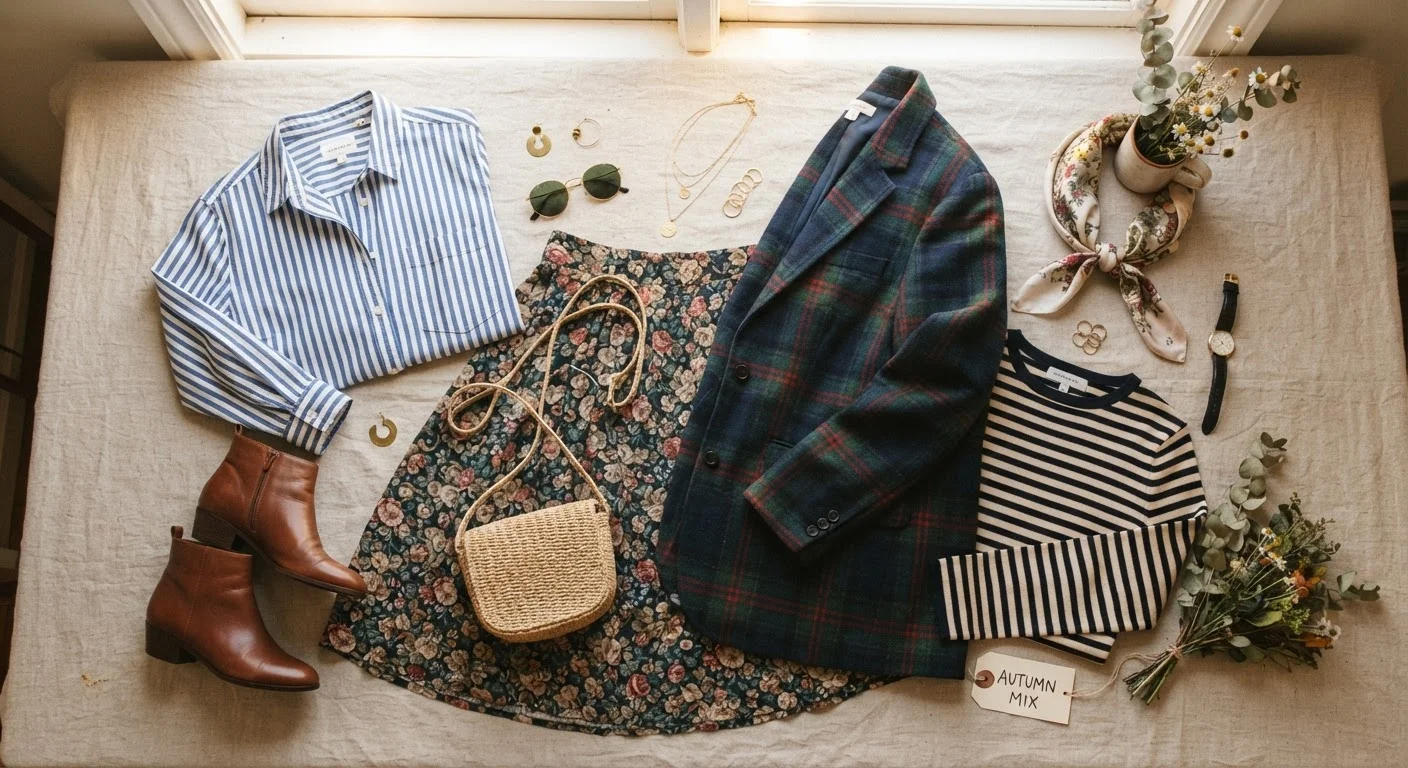
Why Pattern Mixing Feels Risky — and Why It Doesn't Have to
Most people who avoid mixing patterns aren't risk-averse — they're just working without a framework. The combinations that look chaotic usually violate a handful of learnable principles, and the ones that look effortlessly styled almost always follow them, whether intentionally or not.
Pattern mixing isn't about being daring. It's closer to the logic behind color coordination — once you understand what's actually happening visually, the intimidation largely disappears. The same goes for the broader question of why outfits don't always land the way you imagined. Usually it's a structural issue, not a style deficiency.
The Foundational Rules That Make It Work
These aren't arbitrary guidelines — each one maps to how the human eye processes competing visual information. Master these, and mixing becomes repeatable rather than accidental.
Vary the scale of your patterns significantly — think large with small.
When two patterns are nearly the same size, the eye struggles to process them separately, creating visual noise. A clear difference in scale — like a wide bold stripe paired with a tiny floral — gives each pattern its own visual space and makes the combination feel intentional rather than accidental.
Pull at least one shared color across every pattern in your outfit.
Color is the connective tissue of pattern mixing. When patterns share even a single hue — say, the same warm rust appearing in both a floral and a plaid — the outfit reads as cohesive. Without a shared anchor, combinations feel like a coincidence rather than a choice.
Use a solid neutral as a visual buffer between competing patterns.
Two patterns worn adjacent to each other — say, at the waist — are where clashing most often happens. A neutral layer like a solid belt, tucked solid tee, or untucked shirt hem creates breathing room. It also gives the eye a place to rest, which actually makes both patterns stand out more clearly.
Limit your outfit to two or three patterns maximum.
Each additional pattern competes for attention. Two patterns with clear scale and color logic is often all it takes to look intentionally styled. A third can work when it's very small or muted. Beyond that, the effort typically reads as confusion rather than creativity.
Treat pattern family relationships as shortcuts — similar pattern types often mix more easily.
Geometric patterns (stripes, checks, plaids) tend to share a structural logic that makes them more forgiving when mixed together. Similarly, organic patterns (florals, paisley, abstract) share a softness. Mixing within a family first is a lower-risk entry point before experimenting across families.
Rules Are a Starting Point, Not a Ceiling
These principles describe what typically works — not what's required. Fashion history is full of designers who broke these rules on purpose. Understanding the logic behind them means you can bend them deliberately rather than accidentally.
Putting It Into Practice Without Starting Over
You don't need a new wardrobe to start experimenting. Most people already own pieces that can be mixed — they just haven't tested the combinations. Understanding proportion and silhouette alongside pattern logic also helps: a bulkier pattern on a looser silhouette reads differently than the same pattern in a fitted cut.
Start With Stripes as Your Anchor Pattern
Stripes are arguably the most versatile pattern for mixing because they read as semi-neutral at smaller scales. A fine stripe can often stand in for a solid, giving you pattern interest without adding a full competing print. If you're new to mixing, anchor one piece with stripes and build from there.
For context on building a wardrobe that supports this kind of flexibility, see dressing for the season without rebuilding your wardrobe. Versatile pieces that work in multiple combinations are worth prioritizing.
67%
Consumers want to feel confident in clothing choices
A 2023 survey by the Cotton Incorporated Lifestyle Monitor found that feeling confident is among the top motivators American consumers cite when choosing what to wear.
3
Maximum patterns for a readable outfit
Fashion educators commonly cite three as the practical ceiling for pattern mixing before an outfit loses visual coherence — a principle taught in most styling curricula.
Reading the Room: Pattern Mixing Across Contexts
Casual dressing is forgiving territory for pattern experiments. More formal contexts require a lighter touch — but mixing isn't off the table. Two subtle patterns in a professional setting (a fine stripe shirt under a tonal check blazer, for example) can read as polished rather than playful, especially when the color palette stays contained. For navigating specific dress codes, understanding what dress codes actually mean is a useful starting point.
“Pattern mixing isn't about breaking rules — it's about understanding them well enough to know which ones you can push.”
— Tim Gunn, Fashion educator and author
The goal in any context is the same: combinations that look considered. When the principles above are in place — scale contrast, shared color, a neutral anchor — that's exactly how they read.
The content on this site is for informational purposes only and is not a substitute for professional advice. Always consult a qualified professional for guidance specific to your situation.