

The Root Difference (Literally)
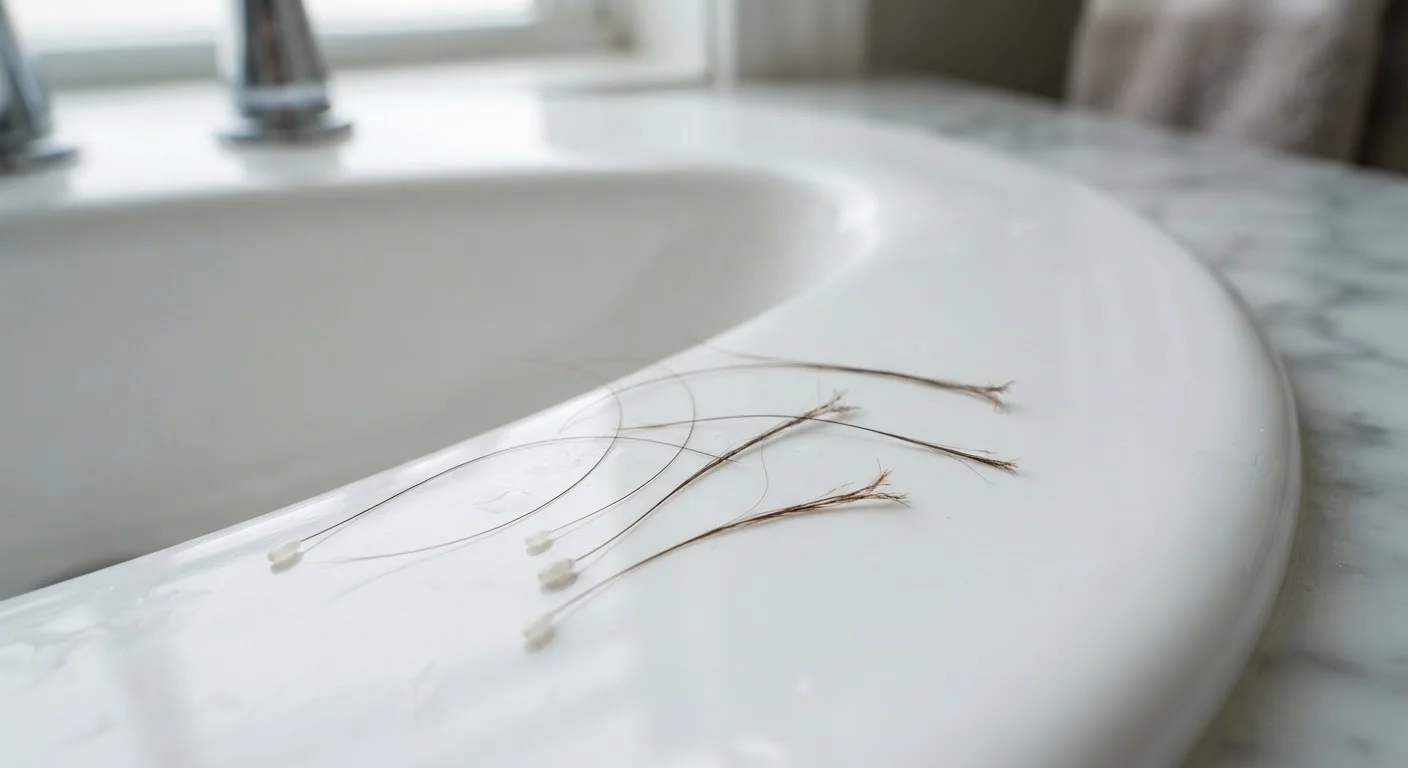
The simplest diagnostic tool you already own is your own hand. Pick up a fallen hair and look at its end. If you see a tiny bulb — it may be white, translucent, or pigmented — that hair shed naturally from the follicle. It completed its growth cycle and released. If the hair simply ends in a rough, frayed, or blunt tip with no bulb, it snapped. That's breakage.
This one observation changes everything about how you respond. Shed hairs come from the scalp; broken hairs come from the strand itself. Two different origins, two entirely different sets of solutions.
50–100
Hairs shed per day considered normal
This general range is widely cited in dermatology literature as part of the typical hair growth cycle.
~90%
Scalp hairs in the active growth phase at any time
At any given moment, roughly 90% of hair follicles are in the anagen (growth) phase, with the remainder resting or transitioning.
2–6 years
Average anagen (growth) phase duration
The length of the active growth phase varies by genetics and health and determines how long hair can grow before it sheds naturally.
What's Actually Happening When You Shed
Every hair on your head goes through a growth cycle: a growing phase (anagen), a transitional phase (catagen), and a resting phase (telogen), after which the hair sheds and the follicle begins again. Losing 50–100 hairs a day is considered within the general normal range — that's your follicles cycling through, not your hair falling apart.
Excessive shedding, however, is a signal that something internal has shifted. Common contributors include significant nutritional deficiencies (particularly iron, protein, and certain B vitamins), hormonal changes such as postpartum shifts or thyroid imbalances, high physical or psychological stress, and certain medications. This type of accelerated shedding is sometimes called telogen effluvium, a temporary condition where an unusually high number of hairs enter the resting phase simultaneously.
Because shedding originates at the follicle level, the response needs to address what's happening inside the body — not what products you're applying to the strand. For a deeper look at what actually influences follicle behavior, see our article on scalp health and hair growth.
“Hair loss is one of the most common complaints I hear, but once patients understand that shedding and breakage are different problems, they stop chasing the wrong solutions. The diagnosis has to come before the treatment.”
— A Board-Certified Dermatologist, Specialist in hair and scalp disorders, paraphrasing a commonly expressed clinical perspective
What's Actually Happening When You Break
Hair breakage is mechanical or chemical in nature. The hair shaft — made of a protein called keratin — can only withstand so much stress before it fractures. Heat styling at high temperatures degrades the protein structure over repeated use. Chemical processes like bleaching, relaxing, and perming alter the internal bonds that give hair its tensile strength. Physical stressors — aggressive brushing, tight elastic bands, cotton pillowcases, and over-manipulation — create friction and tension that wear the strand down.
Signs that breakage is your primary issue: you're finding many short, uneven pieces of hair everywhere; your ends are chronically rough and split; hair feels brittle or snaps easily when stretched gently. Breakage often concentrates at predictable stress points — where a ponytail holder sits, at the nape, or along the mid-shaft where heat tools reach most often.
Unlike shedding, breakage is largely responsive to what you do externally. Our guide to hair damage types and recovery covers what realistic improvement looks like across different damage scenarios. And if your hair feels stiff or mushy alongside breakage, getting the protein-moisture balance right is worth reading before adjusting your routine.
Quick Breakage Audit: The Stretch Test
Take a single wet strand of hair and gently stretch it. Healthy hair with good moisture elasticity should stretch slightly and return without snapping. If it breaks immediately with little stretch, your hair may be lacking moisture. If it stretches dramatically and doesn't spring back, it may need protein support. This simple test can guide whether conditioning or a protein treatment is the more pressing need.
Responding Correctly to Each Problem
Misidentifying the issue leads to wasted effort — or worse, aggravating the real problem. Applying a heavy protein treatment to hair that's shedding due to a thyroid issue won't slow that shedding one bit. And addressing a breakage problem by changing your diet while continuing to use high-heat tools daily won't stop the strand damage either.
For excessive shedding: Start with the internal basics. Consult a healthcare provider to rule out nutritional deficiencies or hormonal imbalances — a blood panel is often the fastest way to surface these. Avoid added mechanical stress on already-vulnerable strands (gentle handling matters when shedding is elevated), but don't expect topical treatments to address the core cause.
For breakage: Audit your external habits. Reduce heat frequency and always use a heat protectant. Examine your styling practices — everyday habits that quietly undermine hair health are often the overlooked culprits. Prioritize moisture retention through conditioning, protective styling (without excess tension), and gentle detangling on wet, conditioned hair.
If you're unsure which problem you're dealing with — or both seem to be happening — run through this checklist before overhauling your entire routine. Changing everything at once makes it impossible to know what actually helped.
Both Problems Can Occur at the Same Time
It's entirely possible to experience elevated shedding and significant breakage simultaneously — for example, postpartum hormonal shifts can drive shedding while existing heat damage continues to cause breakage. Treating them as separate issues with separate strategies is more effective than looking for a single fix that addresses both. When in doubt, a trichologist (a specialist in hair and scalp health) can help distinguish what's driving each concern.
This article is for general informational purposes only and is not a substitute for professional medical advice. If you are experiencing significant or sudden hair loss, consult a qualified dermatologist or healthcare provider.
Frequently Asked Questions
Check the end of each fallen hair. Shed hairs will have a small white or dark bulb at the root, indicating the hair completed its growth cycle. Broken hairs will be shorter, uneven fragments with no bulb. Consistent short hairs across your brush suggest breakage; longer hairs with bulbs point to shedding.
Most hair care and dermatology sources cite a general range of 50–100 hairs per day as typical. This number can vary based on hair density, texture, and washing frequency. Noticing significantly more than this consistently, especially with visible thinning, is worth discussing with a healthcare provider.
Stress can cause both, but through different mechanisms. Significant physical or emotional stress can trigger telogen effluvium, a form of excessive shedding where more hairs than usual shift into the resting phase. Stress-related habits like tight ponytails or infrequent conditioning can also worsen breakage over time.
Deep conditioning targets breakage by strengthening and moisturizing the hair shaft — it won't address shedding driven by internal causes like hormonal shifts or nutritional gaps. If you're experiencing true shedding, conditioning helps maintain the health of remaining strands but does not treat the underlying cause.
Consult a dermatologist or healthcare provider if shedding is sudden or dramatic, if you notice patchy hair loss, if the hairline is receding, or if hair loss is accompanied by other symptoms like fatigue or skin changes. These may indicate an underlying condition that requires medical evaluation.
Protective styling can reduce mechanical breakage by minimizing daily manipulation and friction. However, styles that are too tight or left in too long can actually worsen breakage and even cause traction alopecia, a form of hair loss from sustained tension. Protective styles do not affect shedding driven by the hair growth cycle.
The content on this site is for informational purposes only and is not a substitute for professional advice. Always consult a qualified professional for guidance specific to your situation.