

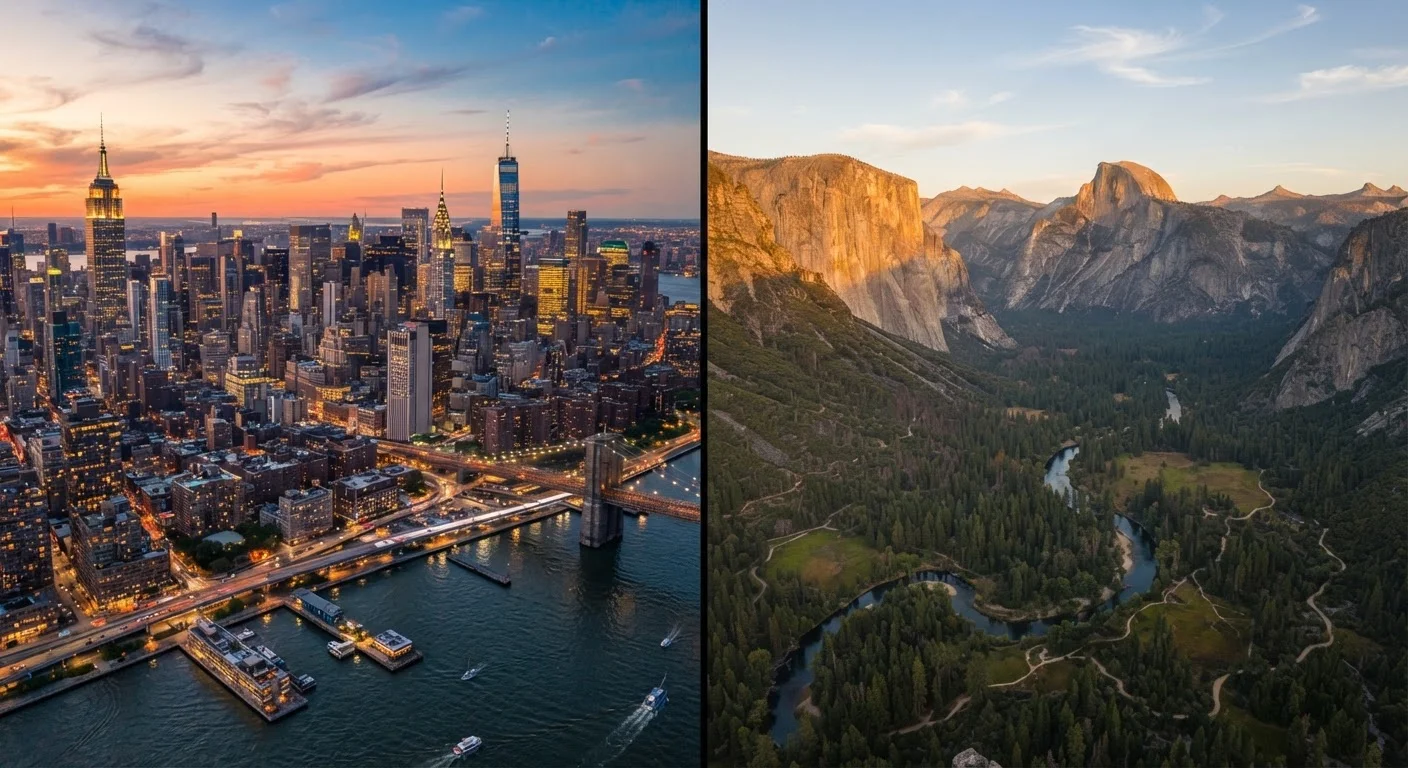
Our Verdict
City breaks win when you crave cultural stimulation, food, nightlife, and low logistical friction. Nature escapes win when you need to decompress, move your body, and disconnect from screens. For most American travelers, the real question isn't which is better — it's which version of yourself is showing up to the trip.
| Best for | Recommended |
|---|---|
| Travelers wanting cultural immersion, dining, and walkable convenience | City Break |
| Those seeking stress relief, physical activity, and scenic solitude | Nature Escape |
| First-time travelers or those with limited planning bandwidth | City Break |
| Travelers on longer trips who want variety and full recharge | Hybrid Trip |
Start With Your Energy, Not a Destination
Before you open a single booking site, pause and ask one honest question: what does your body and brain actually need right now? That answer does more work than any destination ranking.
If you've been sitting through long weeks of meetings, staring at screens, and craving stimulation — a city break feeds that hunger. Museums, restaurants, neighborhoods to wander, live music on a Tuesday — cities deliver variety without requiring much planning infrastructure. You can figure out dinner at 6 p.m. and still eat well.
If you're fried, overscheduled, and dreaming of quiet — a nature escape is your reset button. Hiking through red rock country, paddling a glassy lake at dawn, or simply sitting beside a mountain creek recalibrates something screens cannot. The trade-off: outdoor trips typically demand more logistical prep, from gear to permits to accommodation in less-served areas.
Neither is a better vacation. They're different medicines. Start your decision there. Once you know your energy state, the rest of the framework clicks into place. For a full walkthrough of how to structure your planning from this point forward, see our trip planning anatomy guide.
How Trip Length and Group Shape the Choice
Trip duration is a surprisingly decisive variable. A weekend getaway almost always favors a city — you land, drop your bag, and the experience begins immediately. Nature trips under three days often feel rushed once you factor in drive time to trailheads and the slower pace outdoor settings invite.
A week or longer opens the door to serious nature immersion or a hybrid structure: fly into a city, spend two days exploring it, then rent a car and head into a national park or coastal region. This combo is particularly rewarding in places like Denver (city) paired with Rocky Mountain National Park, or Portland paired with the Columbia River Gorge.
| City Break | Nature Escape | |
|---|---|---|
| Ideal trip length | 2–4 days | 4–7+ days |
| Logistical complexity | Low — plug-and-play | Moderate to high — advance planning needed |
| Physical demand | Low to moderate | Moderate to high |
| Best for recharging | Mental stimulation, inspiration | Stress relief, physical reset |
| Group friendliness | High — easy to pivot plans | Variable — depends on fitness levels |
| Seasonal sensitivity | Moderate | High — weather and permits matter |
| Connectivity & convenience | High — transit, rideshare, walkability | Low — car typically required |
Group composition matters too. Traveling with kids? Cities offer built-in variety when someone melts down — you pivot to a museum, a park, ice cream. Nature trips with young children require honest assessment of fitness and attention span relative to trail difficulty. Solo traveler? Cities provide social texture and safety in numbers; nature escapes can be profoundly solo-friendly but benefit from extra safety planning. Our guide to solo travel in the US covers that territory in depth.
The Practical Trade-Offs: Cost, Logistics, and Accessibility
Neither trip type is categorically cheaper — both have wide cost ranges — but the structure of spending differs. City breaks concentrate costs in accommodation and dining, with lots of free or low-cost cultural options (free museum days, public parks, street life). Nature escapes shift spending toward transportation (often a rental car), gear, and park fees, but lodging in rural areas can be significantly more affordable than urban hotels.
Book Nature Permits Early
Popular US national parks increasingly require timed-entry permits or advance campsite reservations, sometimes months ahead of peak season. Check the official National Park Service website (nps.gov) for current reservation systems before you finalize travel dates. Flexibility on travel days — mid-week vs. weekend — can meaningfully expand your options.
Logistics complexity also differs. Cities are usually plug-and-play: public transit, rideshare, walkable neighborhoods. Nature destinations often require advance planning for campsite or cabin reservations — especially popular parks like Zion, Acadia, or the Smokies, where permits and timed-entry systems are increasingly common. Check official National Park Service sources for the most current reservation requirements before you commit to dates.
Accessibility is another honest consideration. Many urban cultural sites now meet ADA standards. Trail accessibility varies enormously — some parks offer paved, flat routes suitable for wheelchairs and strollers; backcountry routes do not. Factor this in early rather than as an afterthought. Seasonal timing also plays a significant role: summer crowds in national parks rival city tourism peaks, while shoulder seasons often reward nature travelers with solitude and more moderate conditions.
The Hybrid Move: When You Don't Have to Choose
Here's the good news for the indecisive: the US is full of destinations where you genuinely don't have to pick. Some of the country's most satisfying trips weave urban and outdoor experiences together naturally.
- Asheville, NC — a walkable, arts-forward city surrounded by the Blue Ridge Mountains and waterfall hikes
- Salt Lake City, UT — a mid-sized city with a vibrant food scene sitting at the base of world-class ski and hiking terrain
- Anchorage, AK — urban infrastructure as a launchpad for extraordinary wilderness access
- Santa Fe, NM — a culturally rich city paired with high-desert trails and dramatic landscapes
If you're drawn to movement between places rather than a single base, underrated US road trip routes offer a natural way to thread cities and landscapes together into one fluid itinerary. And once you've landed on your approach, balancing structure with flexibility will help you build a schedule that actually holds up on the road.
The content on this site is for informational purposes only and is not a substitute for professional advice. Always consult a qualified professional for guidance specific to your situation.